28203: Difference between revisions

From Bitnami MediaWiki
No edit summary
No edit summary
Line 13: Line 13:
Considerând funcția <math>g: \mathbb{R} \longrightarrow  \mathbb{R}, g(x) = f(x) - e^x </math>, relația din enunț are forma echivalentă <math>g(g(x)) = x</math>, pentru orice <math>x\in \mathbb{R}, (1).</math>


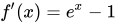
a) Alegem <math>g(x)=-x</math> care verifică (1), și obținem <math>f(x)=e^x-x</math>, care nu este monotonă,, întrucât  <math>f'(x)=e^x-1</math> își schimbă semnul pe <math> \mathbb{R}</math>.
a) Alegem <math>g(x)=-x</math> care verifică <math>(1)</math>, și obținem <math>f(x)=e^x-x</math>, care nu este monotonă,, întrucât  <math>f'(x)=e^x-1</math> își schimbă semnul pe <math> \mathbb{R}</math>.


b) Alegem <math> g(x) = \begin{cases} x,  & x\in \mathbb{Q} \\-x, & x\in \mathbb{R} \backslash \mathbb{Q} \end{cases} </math>, care verifică (1) și obținem
b) Alegem <math> g(x) = \begin{cases} x,  & x\in \mathbb{Q} \\-x, & x\in \mathbb{R} \backslash \mathbb{Q} \end{cases} </math>, care verifică <math>(1)</math> și obținem


<math>f(x)= e^x + g(x) = \begin{cases} e^x,  & x\in \mathbb{Q} \\e^x-x, & x\in \mathbb{R} \backslash \mathbb{Q} \end{cases} </math>. Deoarece <math>f</math> este suma dintre o funcție continuă și alta discontinuă (în orice punct din <math>\mathbb{R}\ast</math> ), rezultă că <math>f</math> este discontinuă.
<math>f(x)= e^x + g(x) = \begin{cases} e^x,  & x\in \mathbb{Q} \\e^x-x, & x\in \mathbb{R} \backslash \mathbb{Q} \end{cases} </math>. Deoarece <math>f</math> este suma dintre o funcție continuă și alta discontinuă (în orice punct din <math>\mathbb{R}^\ast</math> ), rezultă că <math>f</math> este discontinuă.
 
c) Pe baza ipotezelor asupra funcției <math>f</math>, rezultă că <math>g(x)\ge 0</math>, pentru orice <math>x\ge 0</math>, iar <math>g</math> admite primitive, deci are proprietatea lui Darboux. Combinând această proprietate cu injectivitatea funcției <math>g</math>, obținută din <math>(1)</math>, rezultă că <math>g</math> este strict monotonă și continuă.
 
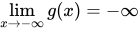
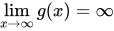
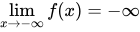
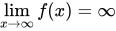
În cazul în care <math>g</math> ar fi strict descrescătoare, pe baza surjectivității funcției <math>g</math>, ce se obține din <math>(1)</math>, am avea că <math>\lim_{x \to \infty}g(x) =-\infty </math>, ceea ce contrazice că <math>g(x)\ge 0</math> pentru orice <math>x\ge 0</math>. Prin urmare, <math>g</math> este strict crescătoare, <math>\lim_{x \to -\infty}g(x) =-\infty </math>, <math>\lim_{x \to \infty}g(x) =\infty </math>, ceea ce conduce la <math>\lim_{x \to -\infty}f(x) =-\infty </math>, <math>\lim_{x \to \infty}f(x) =\infty </math>, iar surjectivitatea funcției <math>f</math> este o consecință a proprietății lui Darboux, în particular a continuității.

Revision as of 12:11, 17 December 2023

28203 (Dana Heuberger, Baia Mare)

Fie Failed to parse (SVG (MathML can be enabled via browser plugin): Invalid response ("Math extension cannot connect to Restbase.") from server "https://wikimedia.org/api/rest_v1/":): {\displaystyle f: \mathbb{R} \longrightarrow \mathbb{R} } o funcție cu proprietatea

Failed to parse (SVG (MathML can be enabled via browser plugin): Invalid response ("Math extension cannot connect to Restbase.") from server "https://wikimedia.org/api/rest_v1/":): {\displaystyle \mathcal{P}: f(f(x)-e^x)=e^{f(x)-e^x} + x} , pentru orice

  1. Dați exemplu de funcție cu proprietatea care nu este monotonă.
  2. Dați exemplu de funcție cu proprietatea care nu este continuă.
  3. Fie f o funcție care admite primitive și are proprietatea . Arătați că, dacă , pentru orice , atunci este surjectivă.

Soluție: Considerând funcția , relația din enunț are forma echivalentă , pentru orice

a) Alegem care verifică , și obținem , care nu este monotonă,, întrucât își schimbă semnul pe .

b) Alegem Failed to parse (SVG (MathML can be enabled via browser plugin): Invalid response ("Math extension cannot connect to Restbase.") from server "https://wikimedia.org/api/rest_v1/":): {\displaystyle g(x) = \begin{cases} x, & x\in \mathbb{Q} \\-x, & x\in \mathbb{R} \backslash \mathbb{Q} \end{cases} } , care verifică Failed to parse (SVG (MathML can be enabled via browser plugin): Invalid response ("Math extension cannot connect to Restbase.") from server "https://wikimedia.org/api/rest_v1/":): {\displaystyle (1)} și obținem

Failed to parse (SVG (MathML can be enabled via browser plugin): Invalid response ("Math extension cannot connect to Restbase.") from server "https://wikimedia.org/api/rest_v1/":): {\displaystyle f(x)= e^x + g(x) = \begin{cases} e^x, & x\in \mathbb{Q} \\e^x-x, & x\in \mathbb{R} \backslash \mathbb{Q} \end{cases} } . Deoarece Failed to parse (SVG (MathML can be enabled via browser plugin): Invalid response ("Math extension cannot connect to Restbase.") from server "https://wikimedia.org/api/rest_v1/":): {\displaystyle f} este suma dintre o funcție continuă și alta discontinuă (în orice punct din Failed to parse (SVG (MathML can be enabled via browser plugin): Invalid response ("Math extension cannot connect to Restbase.") from server "https://wikimedia.org/api/rest_v1/":): {\displaystyle \mathbb{R}^\ast} ), rezultă că Failed to parse (SVG (MathML can be enabled via browser plugin): Invalid response ("Math extension cannot connect to Restbase.") from server "https://wikimedia.org/api/rest_v1/":): {\displaystyle f} este discontinuă.

c) Pe baza ipotezelor asupra funcției Failed to parse (SVG (MathML can be enabled via browser plugin): Invalid response ("Math extension cannot connect to Restbase.") from server "https://wikimedia.org/api/rest_v1/":): {\displaystyle f} , rezultă că Failed to parse (SVG (MathML can be enabled via browser plugin): Invalid response ("Math extension cannot connect to Restbase.") from server "https://wikimedia.org/api/rest_v1/":): {\displaystyle g(x)\ge 0} , pentru orice Failed to parse (SVG (MathML can be enabled via browser plugin): Invalid response ("Math extension cannot connect to Restbase.") from server "https://wikimedia.org/api/rest_v1/":): {\displaystyle x\ge 0} , iar Failed to parse (SVG (MathML can be enabled via browser plugin): Invalid response ("Math extension cannot connect to Restbase.") from server "https://wikimedia.org/api/rest_v1/":): {\displaystyle g} admite primitive, deci are proprietatea lui Darboux. Combinând această proprietate cu injectivitatea funcției Failed to parse (SVG (MathML can be enabled via browser plugin): Invalid response ("Math extension cannot connect to Restbase.") from server "https://wikimedia.org/api/rest_v1/":): {\displaystyle g} , obținută din Failed to parse (SVG (MathML can be enabled via browser plugin): Invalid response ("Math extension cannot connect to Restbase.") from server "https://wikimedia.org/api/rest_v1/":): {\displaystyle (1)} , rezultă că Failed to parse (SVG (MathML can be enabled via browser plugin): Invalid response ("Math extension cannot connect to Restbase.") from server "https://wikimedia.org/api/rest_v1/":): {\displaystyle g} este strict monotonă și continuă.

În cazul în care Failed to parse (SVG (MathML can be enabled via browser plugin): Invalid response ("Math extension cannot connect to Restbase.") from server "https://wikimedia.org/api/rest_v1/":): {\displaystyle g} ar fi strict descrescătoare, pe baza surjectivității funcției Failed to parse (SVG (MathML can be enabled via browser plugin): Invalid response ("Math extension cannot connect to Restbase.") from server "https://wikimedia.org/api/rest_v1/":): {\displaystyle g} , ce se obține din Failed to parse (SVG (MathML can be enabled via browser plugin): Invalid response ("Math extension cannot connect to Restbase.") from server "https://wikimedia.org/api/rest_v1/":): {\displaystyle (1)} , am avea că Failed to parse (SVG (MathML can be enabled via browser plugin): Invalid response ("Math extension cannot connect to Restbase.") from server "https://wikimedia.org/api/rest_v1/":): {\displaystyle \lim_{x \to \infty}g(x) =-\infty } , ceea ce contrazice că Failed to parse (SVG (MathML can be enabled via browser plugin): Invalid response ("Math extension cannot connect to Restbase.") from server "https://wikimedia.org/api/rest_v1/":): {\displaystyle g(x)\ge 0} pentru orice Failed to parse (SVG (MathML can be enabled via browser plugin): Invalid response ("Math extension cannot connect to Restbase.") from server "https://wikimedia.org/api/rest_v1/":): {\displaystyle x\ge 0} . Prin urmare, Failed to parse (SVG (MathML can be enabled via browser plugin): Invalid response ("Math extension cannot connect to Restbase.") from server "https://wikimedia.org/api/rest_v1/":): {\displaystyle g} este strict crescătoare, Failed to parse (SVG (MathML can be enabled via browser plugin): Invalid response ("Math extension cannot connect to Restbase.") from server "https://wikimedia.org/api/rest_v1/":): {\displaystyle \lim_{x \to -\infty}g(x) =-\infty } , Failed to parse (SVG (MathML can be enabled via browser plugin): Invalid response ("Math extension cannot connect to Restbase.") from server "https://wikimedia.org/api/rest_v1/":): {\displaystyle \lim_{x \to \infty}g(x) =\infty } , ceea ce conduce la Failed to parse (SVG (MathML can be enabled via browser plugin): Invalid response ("Math extension cannot connect to Restbase.") from server "https://wikimedia.org/api/rest_v1/":): {\displaystyle \lim_{x \to -\infty}f(x) =-\infty } , Failed to parse (SVG (MathML can be enabled via browser plugin): Invalid response ("Math extension cannot connect to Restbase.") from server "https://wikimedia.org/api/rest_v1/":): {\displaystyle \lim_{x \to \infty}f(x) =\infty } , iar surjectivitatea funcției Failed to parse (SVG (MathML can be enabled via browser plugin): Invalid response ("Math extension cannot connect to Restbase.") from server "https://wikimedia.org/api/rest_v1/":): {\displaystyle f} este o consecință a proprietății lui Darboux, în particular a continuității.