|
|
| (One intermediate revision by the same user not shown) |
| Line 43: |
Line 43: |
| </math>, atunci <math>yf'(x)\geq 0, xf'(y)\geq0 | | </math>, atunci <math>yf'(x)\geq 0, xf'(y)\geq0 |
| </math> și ca mai sus avem <math>yf'(x)=xf'(y) | | </math> și ca mai sus avem <math>yf'(x)=xf'(y) |
| </math>. | | </math>. |
|
| |
|
| În particular <math>f'(x)=-f'(-1)x | | În particular <math>f'(x)=-f'(-1)x |
| </math>, deci <math>f(x)=bx^2 + d, | | </math>, deci <math>f(x)=bx^2 + d, |
| </math> cu <math>b>0 | | </math> cu <math>b>0 |
| </math> și d <math>\in | | </math> și <math>d \in \mathbb{R} |
| </math> ℝ . Cum <math>0 = f(0) = d, | | </math>. Cum <math>0 = f(0) = d, |
| </math> rezultă că <math display="block">f(x) = bx^2, \, x \in \left(-\infty, 0\right]. | | </math> rezultă că <math display="block">f(x) = bx^2, \, x \in \left(-\infty, 0\right]. |
| </math> Pentru <math>x = -1, y = 1 | | </math> Pentru <math>x = -1, y = 1 |
| </math>, avem <math>f(-3b)+\frac{3}{4}b = 3b | | </math>, avem <math>f(-3b)+\frac{3}{4}b = 3b |
| </math>, deci <math>4b^3 = \frac{9}{4}b | | </math>, deci <math>4b^3 = \frac{9}{4}b |
| </math> | | </math> și cum <math>b> 0 |
| | |
| și cum <math>b> 0 | |
| </math>, rezultă <math>b = \frac{3}{4}. | | </math>, rezultă <math>b = \frac{3}{4}. |
| </math> | | </math> Obținem <math display="block">f(x) = \frac{3}{4}x^2, x \in \mathbb{R} |
| | | </math>funcție care verifică ipotezele din enunț. |
| Obținem <math>f(x) = \frac{3}{4}x^2, x \in | |
| </math>ℝ , funcție care verifică ipotezele din enunț. | |
27036 (Radu Pop)
Să se determine funcțiile derivabile  cu proprietățile:
a)  este funcție strict crescătoare;
b) 
c)  , oricare ar fi
  .
.
Soluție:
Cum  , rezultă că
  este strict crescătoare, deci injectivă pe
  .
.
Deoarece expresia  este simetrică în variabilele
  și
și  , din ipoteza c) rezultă că
  . Din injectivitatea funcției obținem
  , pentru orice
  .
.
În particular,  , deci
 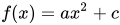 , unde
  și
și  ℝ . Pentru avem
  , deci
  . Rezultă
  , deci

Dacă
![{\displaystyle x,y\in (-\infty ,0]}](https://wikimedia.org/api/rest_v1/media/math/render/svg/2a26d62cbdf55d8b78cf6d779c73cfe7301efe33)
, atunci

și ca mai sus avem
.
În particular  , deci
  cu
cu  și
și  . Cum
. Cum  rezultă că
![{\displaystyle f(x)=bx^{2},\,x\in \left(-\infty ,0\right].}](https://wikimedia.org/api/rest_v1/media/math/render/svg/66d5dd759f7c8c5b8e79b420335a855b2268a37d)
Pentru

, avem

, deci

și cum
, rezultă

Obținem

funcție care verifică ipotezele din enunț.
